

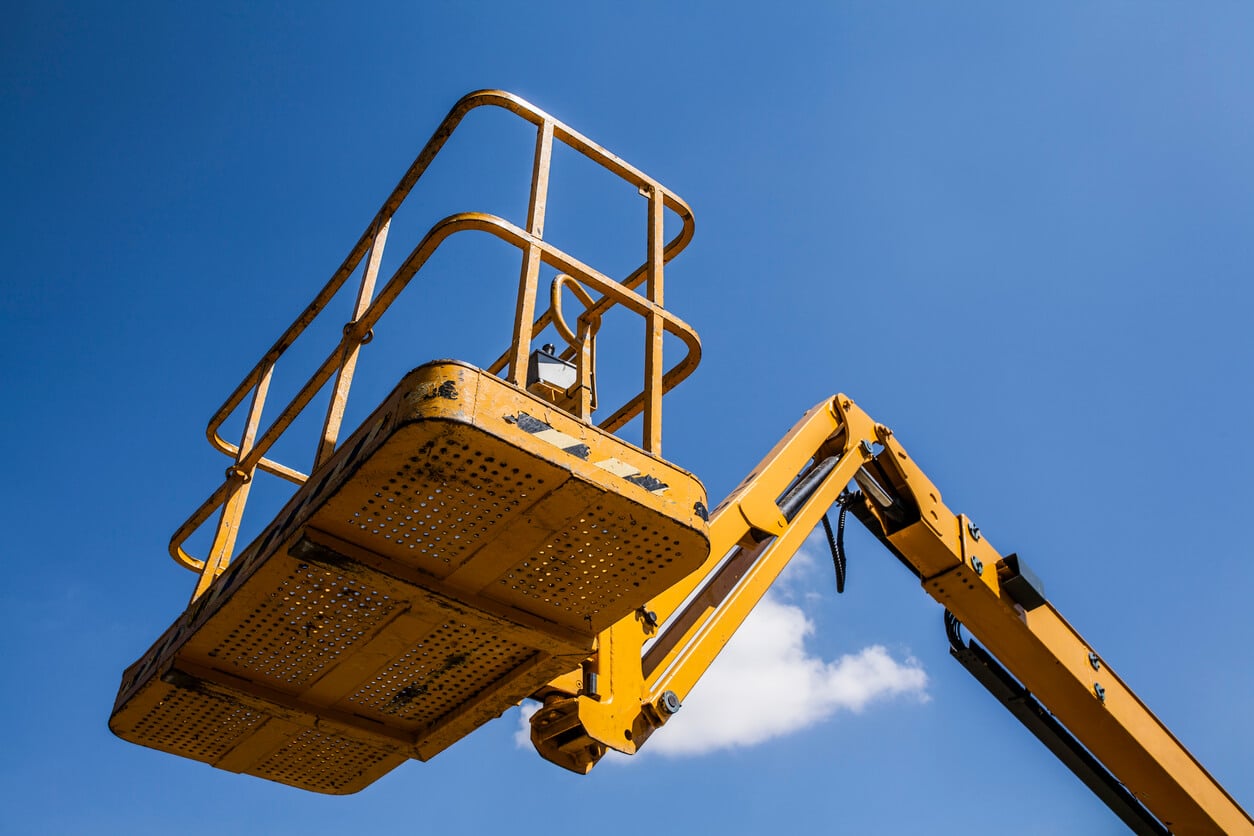
“Between 2011-2014, 1,380 workers were injured as a result of operating an aerial lift or scissor lift,” reports the Centers for Disease Control and Prevention (CDC). (2) The CDC also indicates “87 workers died as a result of operating an aerial lift or scissor lift.” (3)
Why Are Man Lifts and Bucket Trucks Used?
Man lifts and bucket trucks are often used by workers in place of scaffolding. The workers use them when performing installation of drywall, painting, or doing a variety of maintenance tasks. (4)
Industries where aerial lifts are frequently used include: (5)
- Construction.
- General building maintenance.
- Telecommunications.
- Warehousing.
Other industries requiring the elevation of workers to move materials, change lightbulbs, or store boxes, may also utilize aerial lifts.
The use of any aerial lift has possible risks to workers.
Risks Associated with Man Lifts and Bucket Trucks
Hazards associated with elevating workers to perform tasks are numerous and varied.
Some of the most common hazards include: (6)
- Entrapment: Entrapment happens when an occupant of a lift is caught in between, or crushed, between the controls or the guardrails of the platform and an external object, explains the International Powered Access Federation (IPAF). Their worldwide data indicates, “A 75% increase in entrapment reports” in 2024 and “An 87% increase in the number of people involved.” (7) Roughly 6% of all construction hazard incidents in 2022 were associated with getting caught in-between. (8)
- Electrocution: The Electrical Safety Foundation International (ESFI) in 2025 notes, “Electrical fatality rates per 100,000 workers have remained consistent while overall fatality rates have increased.” (9) The IPAF Global Safety Report 2025 notes the U.S. submitted the most reports on electrocutions and electric shock incidents, accounting for 70% of incidents in 2024. (10) According to an online lift certification provider, these electrocutions result from “contact with overhead power lines.” (11)
- Falls: National Safety Council data indicates 39% of construction deaths were from slips, trips, and falls in 2023. (12) One construction professionals company claims there are 3.5 fatal injuries per 1,000 workers per day or the equivalent of “12-14 fatal occupational injuries each day.” It adds, “Delving deeper into the data, it becomes evident that the construction sector remains particularly prone to accidents, with nearly half of all incident reports concerning powered access equipment originating from this industry.” (13)
- Tipovers and collapses: Regarding “incidents resulting in deaths or major injury, overturns was the top cause of accidents in 2024,” according to IPAF. (14) In its Global Safety Report 2025, IPAF states, “The USA accounted for 58% of all incidents” and “Most overturn incidents occurred in the construction industry (nearly 60%).” (15)
- Struck by or against: Overall, a 75% increase in deaths from lift accidents were associated with being struck by falling objects and an 86% increase in the number of people involved in incidents. The U.S.A. accounted for 76% of all incidents. People involved by machine category were 54% mobile boom, 23% static boom, 8% mobile vertical, and 15% other. (16)
It is clear, some professions are more at risk for lift accidents than others.
If you’re a victim of a man lift or bucket truck accident, contact us today to understand your legal rights.
Get a Free Case ReviewAt-Risk Professions
Workers in certain professions are more at risk because they tend to use aerial lifts, such as man lifts and bucket trucks. In addition to raising workers into the air, aerial lifts are mobile and considered a restricted workspace.
They “are used in a number of different conditions, such as adverse weather conditions and high-traffic, continually-changing worksites.” (17)
Professions at greater risk for lift accidents include: (18)
- Carpenters.
- Construction laborers.
- Electricians.
- Electric installation and repair professionals.
- Painters.
Main Lift Hazards
Lift accidents can be hazardous. Accidents can be due to weight and reach concerns. Or they may be due to stabilization and positioning issues, such as working on uneven surfaces. Weather conditions are also a concern. (19)
Electrocution is a serious lift accident hazard, but there are other possible injuries which warrant close attention, as well.
Injuries from Man Lift and Bucket Truck Accidents
Injuries sustained in man lift and bucket truck accidents range from minor to life-threatening, to fatal. Here are some of the most common injuries:
- Death — Boom-supported fall deaths can occur while moving the lift with workers already elevated in it. Other causes of fall deaths include ejection from the lift after being struck by an object. (20)
- Traumatic brain injury (TBI) — Falls are a major cause of TBI. “Traumatic brain injury is usually caused by a blow or other traumatic injury to the head or body. The degree of damage can depend on several factors, including the nature of the injury and the force of impact,” indicates the Mayo Clinic. (21)
- Spinal cord injury (SCI) — SCIs “are caused by trauma to the vertebral column, thereby affecting the spinal cord’s ability to send and receive messages from the brain to the body’s systems that control sensory, motor and autonomic function below the level of injury,” explains the American Association of Neurological Surgeons. (22)
- Burns and electrocution — These occur most often when lifts make contact with overhead power lines. (23) There is also a risk of being struck by lightning while operating a lift. (24)
- Broken bones, fractures — Broken bones or fractures can be life-threatening, especially when there are complications. These life-threatening complications include: vascular damage; collapsed lung; broken and detached segment of rib cage; respiratory compromise; pneumonia, and blood clots. (25)
If you sustained injury from a man lift or bucket truck, you may be eligible for compensation. Contact us today for a free case review.
Get a Free Case ReviewLegal Options
Most of these injuries may require extensive and costly medical treatments. If you have suffered one of these injuries, you may face rising medical bills, lengthy recovery times, loss of income or worse, permanent damage. This is why you should speak with an attorney about all of your legal options.
The individual operating a lift or machine is responsible for damage and injuries caused during its use. If an operator was negligent and someone was injured, the injured party may be entitled to compensation.
Is it Negligence?
Negligence is a legal concept indicating the operator of the lift or machine failed to act “with the level of care that a reasonable person would have exercised under the same circumstances.” (26)
To prove negligence, you must show the court the operator of the lift could foresee the possibility of harm, the severity of that harm, and did not take steps or precautions to eliminate that harm. (27)
Examples of Aerial Lift Negligence
For example, if you were hurt while working in the bucket of a lift that tipped over because the lift hit a curb or hole while moving. Proper maneuvering of the lift is the operator’s responsibility.
Or what if the lift tipped over because the operator did not know or adhere to the rated load capacity for it? Operators are supposed to be aware of and follow recommended guidelines for how much weight a given lift can support to operate the lift safely.
If the operator did not receive the necessary training, the company could be responsible. Companies must provide proper training in areas of health and safety on the job.
If the man lift or bucket truck malfunctions, it could be due to a manufacturing defect in the aerial lift itself. If so, the manufacturer of the aerial lift could be held responsible legally.
How W&L Can Help
Negligence cases are not always clear cut. They can be very complex. This is an area of law where Weitz & Luxenberg has a wealth of experience and a long history of success for our clients.
Some of our success in personal injury and negligence cases include:
- Verdict of $2.96 million for our client. He lost part of his leg when a co-worker drove a hi-lo into a conveyor belt on a sorting room floor lacking adequate barriers.
- Verdict of $20.5 million plus another $3 million for past and future medical expenses for our client. He was the victim of a hit-and-run car accident leaving him paralyzed from the chest down.
- Recovered $10 million for our client. A teenage boy lost sight in one eye while on a school trip. A zip line accident occurred when he was struck by a broken bungee cord acting as a brake.
Updated April 2026