

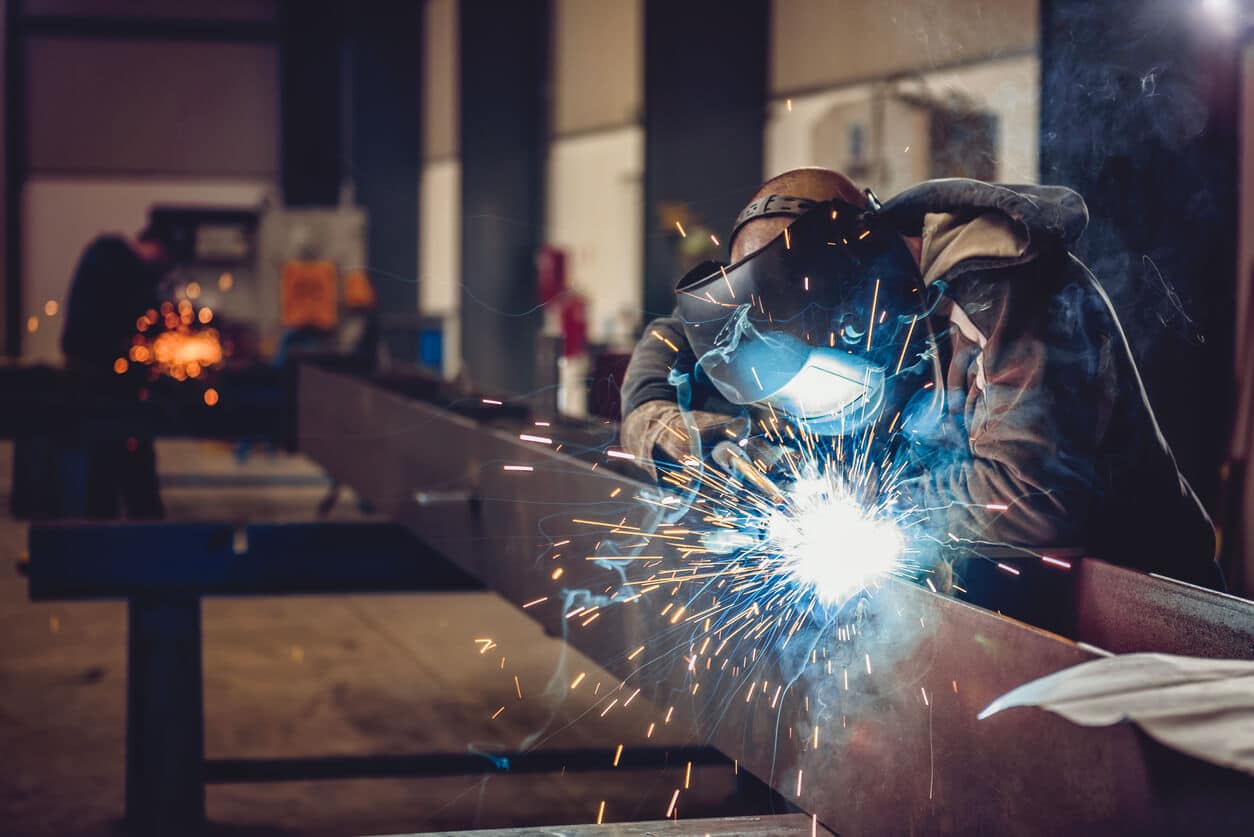
What Are Welding, Cutting, and Brazing?
“Welders, cutters, solderers, and brazers use hand-held or remotely controlled equipment to join or cut metal parts. They also fill holes, indentations, or seams in metal products.” (3) Welding may involve the use of blow torches or electric arcs. Sometimes welding involves use of “oxy-acetylene gas, electrical current, lasers, electron beams, friction and chemical reactions.” (4)
Unlike welding, “Cutting involves heating the metal with a frame and directing a stream of oxygen along the line to be cut.” (5)
“Brazing is a process similar to welding in that a liquid filler metal is heated and flows between two or more metal surfaces to be joined.” (6) However, “Brazing joins metals without melting the base materials, using a filler metal with a lower melting point that bonds the surfaces through capillary action.” (7)
Workers At Risk
The U.S. Bureau of Labor Statistics (BLS) reports 53 fatalities among welders, cutters, solderers, and brazers in 2022. (8) Welding is a vital industry with over 360,000 certified professionals. However, it can be dangerous, with around 30 fatalities annually. (9)
While the causes of welding accidents are numerous, most can be prevented. A significant factor leading to welding incidents resulting in injuries is failures in training.
If you’ve suffered serious harm from a welding accident, a lawsuit can help your recovery.
Get a Free Case ReviewCauses of Injury
Welders work in areas ranging from the automotive industry to construction projects. Welders are also needed in aerospace, green energy, manufacturing and shipping and shipbuilding. (10) Yet, “Lack of proper training is a leading cause of accidents,” says the OSHA Education Center. (11)
Other causes of welding, cutting, and brazing injuries are:
- Fires and explosions. Heat and flammable gases or materials could lead to fires or explosions. (12)
- Electrical shock. This happens when “two energized parts touch — or if you accidentally complete a circuit by touching metal while handling live wires.” (13)
- Excessive noise. “Continuous exposure to noise levels above 85 decibels can lead to permanent hearing loss. Additionally, flying debris or sparks may cause direct damage to the ears.” (14)
- Defective equipment. “Equipment failure due to wear and tear or lack of maintenance can lead to dangerous malfunctions, significantly increasing the risk of injury,” cautions OSHA. (15)
- Fumes and gases. Exposure to emissions of hazardous fumes, like metal oxide compounds and manganese, are a serious health risk. Failure to control exposure to fumes and gases can lead to serious chronic conditions like respiratory illnesses. (16)
- Optical hazards. When exposed to different types of radiation, your eyes can be damaged. This includes ultraviolet, infrared, and visible radiation. (17)
- Difficult environments. Working in challenging environments like twisty, cramped spaces and bad weather conditions can be hazardous. (18)
Welding Injuries
Welding accidents can result in a variety of possible injuries. “Health hazards from welding, cutting, and brazing operations include exposures to metal fumes and to ultraviolet (UV) radiation. Safety hazards from these operations include burns, eye damage, electrical shock, cuts, and crushed toes and fingers.” (19)
Common welding injuries include:
- Burns. These injuries can range from mild to lethal. Burn injuries result from the intense heat and pressure used in the welding process. These injuries are caused by heated metal and tools. (20)
- Radiation damage. Exposure to ultraviolet radiation or infrared radiation can cause acute and long-term eye damage, skin and lung cancer, Parkinson’s Disease, stomach ulcers, and skin conditions. (21)
- Eye damage. There is a risk of vision loss, due to “Eye damage from bright arc rays, flying foreign bodies, and particulates.” (22)
- Electric shock. This can happen when “touching two metal objects that have voltage between them,” (23)
- Exposure to fumes and gases. During welding, fumes from metals can damage your lungs. Exposure to chemicals, such as hexavalent chromium, can cause cancers of your lungs, paranasal sinuses, and nasal cavity. (24) (25)
- Hearing loss. Noise is another welding hazard. “The high-pitched whine of angle grinders, the thunderous roar of plasma cutters, and the sheer cacophony of clanging metal can all take a devastating toll on our sensitive ears.” (26)
- Neurological Issues. Welding fumes can have damaging neurological effects resulting in changes in mood, short-term memory, altered reaction time, and reduced eye-hand coordination. Metal exposure can cause “abnormal accumulations of manganese in the region of the brain… which plays an important role in movement regulation.” (27)
If you have sustained serious injuries from a welding accident, it is best to consider all of your legal options. An attorney can help you explore those options and take steps toward remedying your situation financially.
Legal Options
Welding lawsuits cases may fall under the legal concept of negligence. “Negligence is the failure to behave with the level of care that a reasonable person would have exercised under the same circumstances. Either a person’s actions or omissions of actions can be found negligent.” (28)
When a welding accident results in a fatality, the case may fall under wrongful death. This is defined as, “a civil cause of action brought by family members and dependents against individuals who knowingly or negligently cause the death of another person.” (29) Wrongful death claims are usually brought by family members to gain compensation for the loss of both their loved one and their loved one’s income. (30)
Were you or a loved one injured in a welding accident? You may be eligible for compensation.
(917) LAWYERSWho Is Liable?
In welding accident cases, employers not providing a safe working environment may face liability for injuries sustained on the job. For example, if workers are welding in areas where there is not proper ventilation and engineering controls have not been employed or are inadequate. Engineering controls may include such things as “providing local exhaust ventilation (LEV).” This may involve “Adding a flange to the LEV hood” to increase capture of fumes. (31)
Another instance where an employer may be liable is if it does not provide safety gear or adhere to proper Occupational Safety and Health Administration (OSHA) safety standards and guidelines.
Manufacturers can be held accountable if faulty equipment or equipment design resulted in injury. For example, a design flaw of valves on an acetylene tank leads to an explosion.
It is not only workers who can be permanently injured, or die, from a welding accident. A person passing by when someone is welding could also fall victim to flying sparks and end up blinded or scarred.
How W&L Can Help
Welding accidents can result in catastrophic injuries, but obtaining compensation for those injuries often requires legal action. This is where an experienced attorney can help.
W&L has helped clients for nearly 40 years. We have a successful history of obtaining compensation for our clients in personal injury cases, like welding accidents. We hold those responsible accountable for the harm done to our clients.
Some of our successes include:
- W&L recovered $2.96 million after a negligent co-worker driving a hi-lo overturned it, amputating part of our client’s leg. The company was also found accountable for the accident because there were not adequate vehicle barriers around the pit where the men were working.
- W&L recovered $10 million for our client when a negligently designed bungee cord brake system failed. The brakes for the zip line he was on broke and struck him in one eye, resulting in permanent blindness in the eye.
Updated April 2026